A study led by Bastien Paris, with researchers from the Annecy Behavioral Science Lab and the European Commission’s Joint Research Centre, has been published in Collabra: Psychology. “Evaluating Loneliness Measurements across the European Union” tests how well the common loneliness questionnaires work in all 27 member states.
The team analysed data from 25,646 people across the EU. Only the Three-Item UCLA Loneliness Scale gave scores that can be compared across all countries, and it mainly picks up the painful feeling of loneliness. The Six-Item De Jong Gierveld Scale showed the strongest construct validity, in 25 of 27 countries, but its scores were comparable in only 5. The single question on how often people feel lonely failed validity checks in 8 countries.
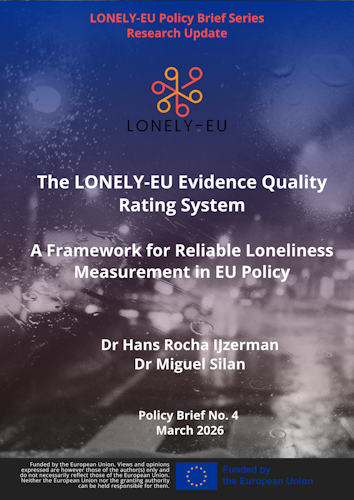
The study is a registered report, so its methods were reviewed and accepted before the results were known. Its findings underpin LONELY-EU Policy Brief 3 and Policy Brief 4, and the traffic light system the project uses to rate loneliness measures.
Authors: Bastien Paris, Ivan Ropovik, Miguel Silan, Béatrice d’Hombres, Elizabeth Casabianca, and Hans Rocha IJzerman. The article is open access.