van de Kletskassa bij de Jumbo in Udenhout, 27 september 2021. Foto: Photo Republic / Marco De
Swart
Supermarkets play an important role in our lives. For many people, that’s the way to get your weekly groceries. The convenience of the offer under one roof makes it easy to quickly stock up on everything you need. They offer a (large) range and have a clear focus on price and efficiency.
In recent years, self-scanning has increased significantly. The customer scans the groceries himself and pays at a payment terminal. In most cases, no other person is involved. Self-scanning speeds up shopping for the customer. More payment terminals can be placed on the same surface so you pay faster, and there are often no queues, such as in front of the cash register. For the supermarket, savings are made on personnel costs and more turnover can be made.
More than just groceries
That is why it is striking that Jumbo is partly going against the current of more efficiency and speed. Jumbo has had the so-called “Kletskassa’s” for a number of years where people can have a chat with the person behind the cash register. These have been introduced in approximately 200 stores and Jumbo recently announced that it will organize Kletswandeling from 50 stores throughout the Netherlands for customers in the neighborhood.
Because, a supermarket is more than just a place where you get your groceries for a large group of people. These are not just the elderly, by the way. It is a moment when you get out of your house for a while, a bit of exercise perhaps, but above all, and this is important to realize, a moment to speak to others. Neighbors, the cashier behind the cash register, or just getting in touch with other people you don’t know.
In this article I am going to look at who the Kletskassa’s and Klets wandelingen are intended for and why Jumbo is so active with this.
Loneliness
The reason for the introduction of the so-called Kletskassa’s is very simple: more and more people feel lonely. According to a recent report by the WHO , one in six people worldwide. These are not necessarily only old people, young people can also feel lonely.
Loneliness does not discriminate and whether you are rich or poor, young or old, you can always start to feel lonely at some point in your life.
And in a way, that’s not a problem because loneliness is a trigger for many people to seek contact with other people.
Chronic loneliness
Loneliness becomes a problem if it is long-term or in other words chronic. People who are chronically lonely are often also less healthy but have a greater demand for care, reduced labor productivity, a shorter life expectancy and a greater risk of the diseases and disorders. The aforementioned WHO report states that 100 people die from loneliness worldwide every hour.
The report also indicates that there is hope, because there are so-called interventions that work and that can be scaled up to break loneliness. There are the Kletskassa’s and the Klets wandelingen of Jumbo are some of the possibilities. But the presence of a supermarket in a village is also an important factor. Aardenburg in Zeeuws Vlaanderen has not had a supermarket for about a year. For groceries you have to go to another village, about eight kilometers away. Supermarkets and good public transport are important, the lack of good facilities promotes loneliness.
Research into Loneliness
Loneliness is very clearly a field that is very much researched by universities, both into causes and solutions.
Various European research programmes have also been started in the field of loneliness to reduce it. Former MEP Judith Merkies has fought for years in the European Parliament to get loneliness on the agenda. Loneliness not only has a social aspect but also an economic aspect and even an aspect of social safety. A few years ago, the first major European study on loneliness was done by the EU Joint Research Centre, which conducts research to support policymakers.
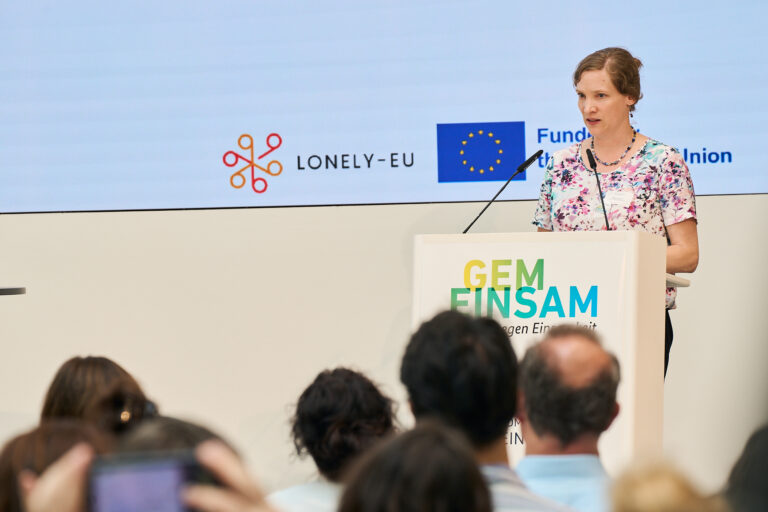
My own involvement in loneliness is that I am the communication manager of one of the European research programs (LONELY-EU) that also includes the aforementioned Judith Merkies as a Policy Expert. LONELY-EU is a project in the field of loneliness and our task is (among other things) to arrive at the so-called Evidence Based Policy Recommendations, in other words, interventions that policymakers can apply that have proven themselves in practice and with which loneliness can be reduced.
What does Jumbo do?
The idea for the Kletskassa arose around 2019 and was conceived on the initiative of Colette Cloosterman-van Eerd, the current Chairman of the Supervisory Board of Jumbo. In the summer of 2019, the first Klets Kassa was opened in Vlijmen in Brabant. After that, more Klets Kassa’s were gradually opened. Later, other initiatives were added. Klets Kassa’s can be found throughout the country at 200 Jumbo stores.
But Jumbo goes further, they realize that they can play an important role in the quality of life in a neighborhood. It also gives marketers the opportunity to emphasize that role.
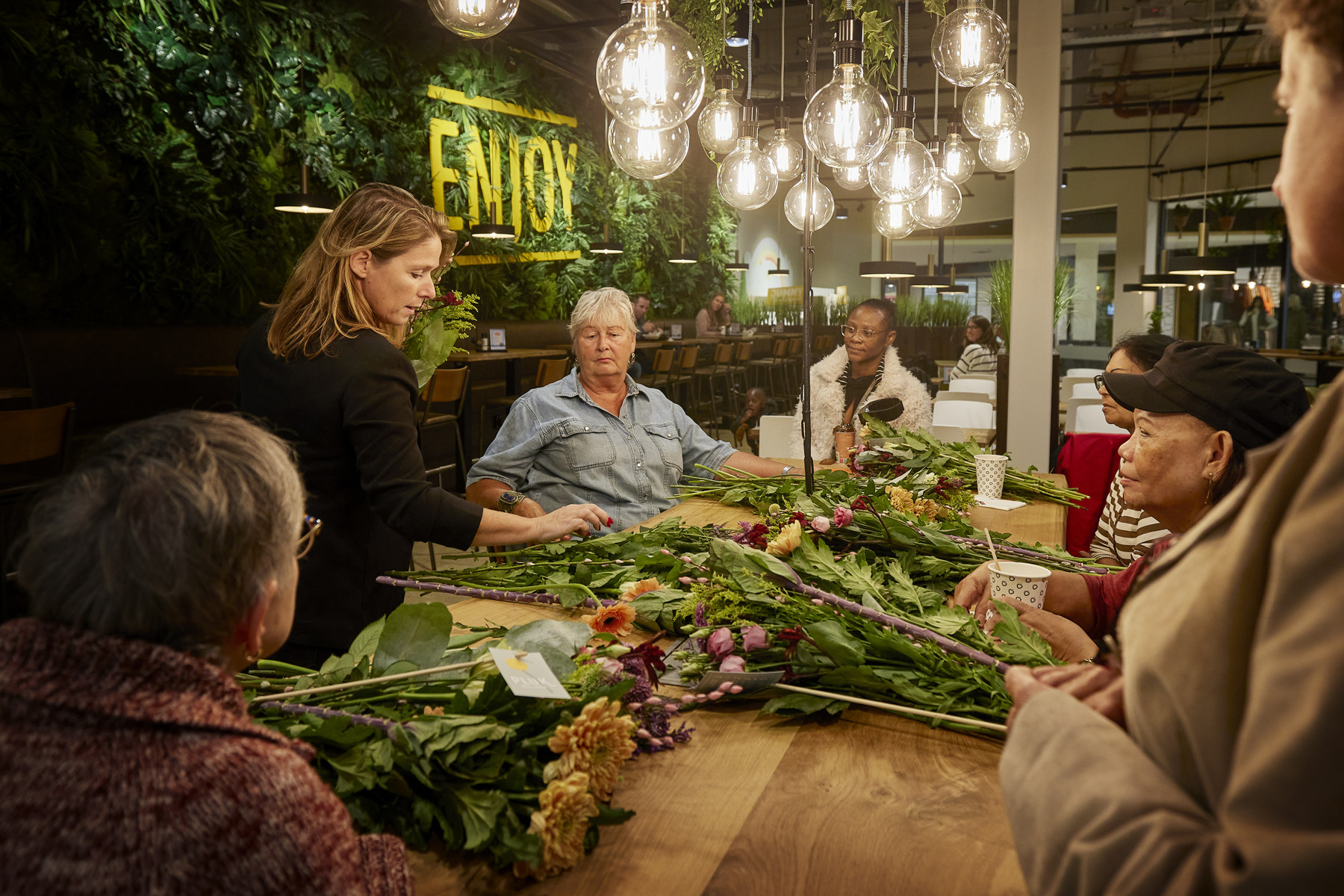
There are many and different types of initiatives; From large joint initiatives such as Kletskassa’s, binding flowers (Kletsboeketten) to hand out to someone else and Klets wandelingen, to local initiatives.
For example, there was a campaign ‘Together for a better neighbourhood’ in 2024. Each store received an extra 1,000 euros to invest in the neighborhood. In Eerbeek, Jumbo donated trees and plants to the local primary school to make the playground greener. Because you can also solve loneliness by investing in the quality of life.
It comes from the top
Colette Cloosterman-van Eerd, Chairman of the Supervisory Board of Jumbo Supermarkets and member of the National Coalition against Loneliness, is closely involved and initiator of o.a.de KletsKassa’s.
Personal experiences in her own environment gave her the idea to initiate this.
In my opinion, this is a very good way to safeguard these kinds of processes in a sector that has made speed and efficiency a top sport.
What does emerge is that bottom-up initiatives are also being developed. Because, thinking that you want to introduce a chat checkout can be done perfectly well from the top of the organization, the implementation is of course up to the stores.
Walking is an accessible way of exercising and with the chat walks you combine the social and physical. This way of moving is accessible to many people. You may have seen the commercials of an anti-loneliness campaign . This is an initiative of the Ministry of Health, Welfare and Sport in which Jumbo is a partner and Colette Cloosterman-van Eerd is on the board.
Local initiatives
Jumbo has also compiled a Loneliness Handbook for the stores. In this they show in a simple way that employees can recognize loneliness in customers and can deal with it in a positive way. The employees see the customers more often and are perhaps one of the few contacts that some people have.
A kind word, a greeting and recognizing people is already a very good first step to do something about loneliness. Jumbo is also looking for connections with local, municipal coalitions about cooperation opportunities with the stores.
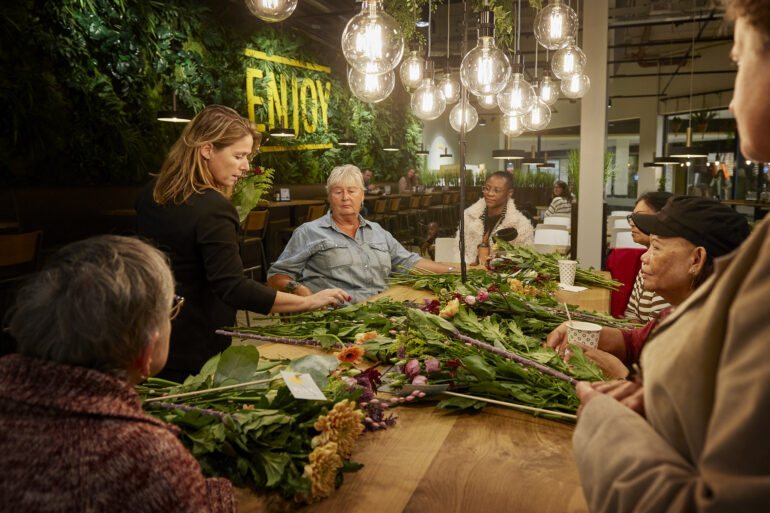
Because it is better to join a certain initiative than to set everything up yourself. Jumbo also participates in the Week against Loneliness every year with our Kletsboeketten. In 2024, activity will be linked to this in the form of a workshop Making a Kletsbouquet (flower binding). More than a hundred shops participated and hundreds of customers made a Kletsbouquet for someone else.
But does it work?
At Kletskassa’s, people can have a nice chat while paying for the groceries at their leisure. These cash registers have been a great success for years, says Jumbo. Any Jumbo store that wants to can participate. Of course, it is a puzzle to fit this into normal business operations, but the stores know the neighborhood (enjoyed) and customers like no other and know very well what best suits their environment and which employees are enthusiastic about walking along.
It is also on a voluntary basis, but according to Jumbo, many employees are enthusiastic who are open to a chat in the neighborhood. It is important that someone who knows the customers and the neighborhood walks along. Employees are not specifically trained on this subject, other than through the handbook.
You can say that when the cash registers and walks are well attended, at least a demand is met. The walks are for young and old. It is possible that more older people participate because they have more time than young people. The interpretation is done locally, i.e. when, where and so on.
But are those people also less lonely? That is not easy to answer, because I don’t know of any studies in which this has been scientifically investigated. To really answer the question, research is needed that measures the impact on the feeling of loneliness that people experience.
I’m not saying that what Jumbo does doesn’t make sense, on the contrary, it’s very valuable and fun to do because humans are social beings. A person often flourishes from attention, if people participate in it you can assume that it makes a positive contribution and that gives a good feeling.
Can this be copied?
Jumbo has now included KletsKassa’s and Kletswalks as standard activities that stores can carry out in the context of social connection. The head office supports with means of communication, but as mentioned, the implementation is locally focused. If a store has a good idea, they can implement it, possibly with the help of the head office. The employees can also think about what they can do based on the local situation and customers.
Not only the stores are participating, the office organization and the supply chain can also participate. It is also a way for a store to position itself in a role they have in a neighborhood, that of meeting place and connection maker.
It’s all on connection and I think it’s very easy to copy.
Because as the English say “Imitation is the sincerest form of flattery” or in good Dutch, “Better well copied than badly conceived”.
If you as an organization would like to copy this concept, feel free to do so.
Copying in this case is not slavishly copying but adapting to your organization, business or customer group. It does have an impact on your business operations because you will have to arrange, fit in or adjust things differently. Without linking it to an increase in turnover.
In this case, that’s not what Jumbo is about, and that’s special. Unselfish? Yes, actually. The impact on society, social connections and being a partner in the neighborhood, that’s where the profit lies.